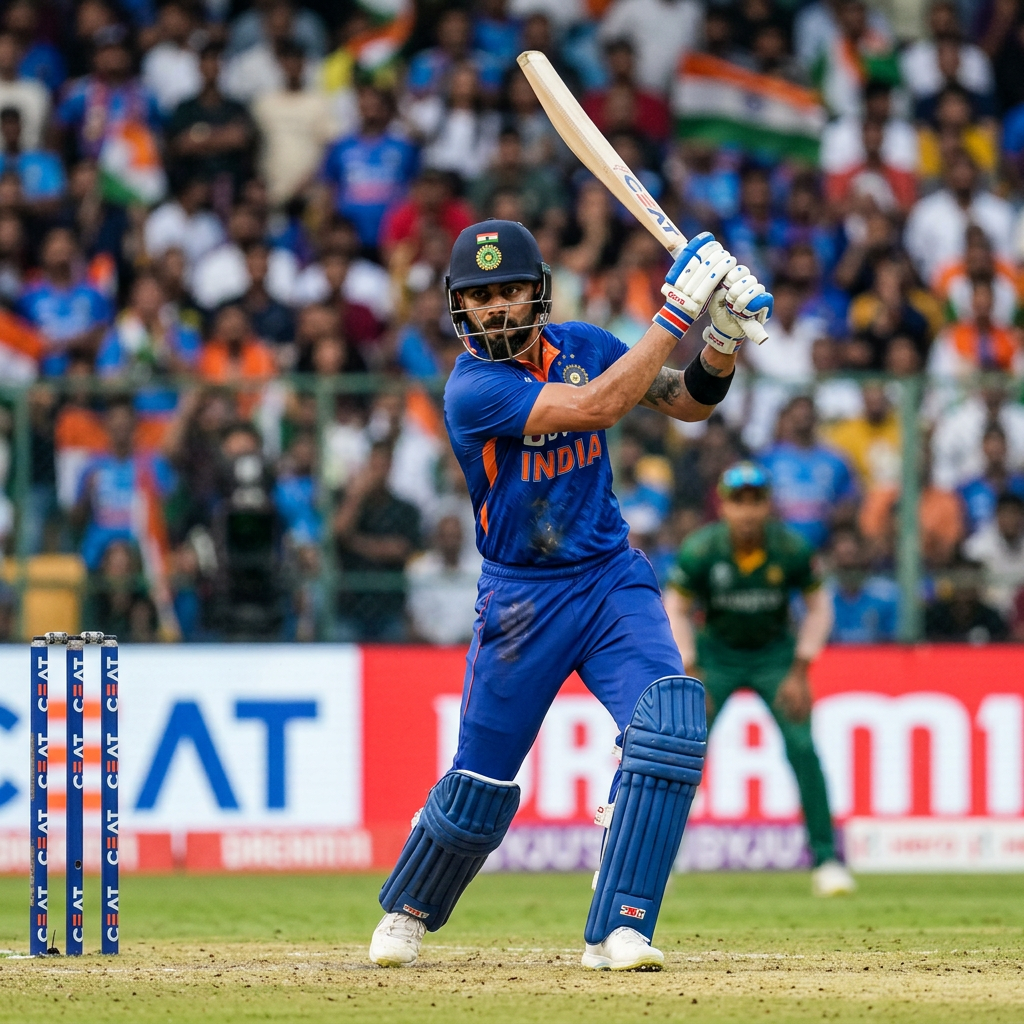
Article excerpt: India’s four-run victory over New Zealand in Wellington was about more than taking a 2–0 lead in an ODI series. It carried a piece of cricket history with it. India recorded its 11th victory over New Zealand across international formats in 2026, moving past the previous benchmark of 10 wins achieved by Ricky Ponting’s Australia in 2005. The achievement is significant, but the numbers deserve a closer look. It is a story about sustained performance across formats, a changing Indian cricket system and the challenge of turning dominance into consistency when the opposition is one of the world’s most competitive cricketing nations.
English article
A record 21 years in the making
Records in cricket often come with a familiar image: a packed stadium, a final-ball finish or an individual performance that changes a match. Sometimes, however, the most interesting records emerge from a longer pattern.
On 7 November 2026, India defeated New Zealand by four runs under the Duckworth–Lewis–Stern (DLS) method in the second ODI at Wellington's Hnry Stadium. The result gave India a 2–0 lead in the five-match series. It also marked India's 11th victory against New Zealand across international formats during the calendar year.
That took India past a record associated with one of the strongest Australian teams of the modern era. Ricky Ponting's Australia had recorded 10 victories against New Zealand in 2005. For 21 years, that remained the benchmark. India moved beyond it with the Wellington result.
Mint+2The headline is compelling, but the achievement is best understood precisely: this is a record for the most victories by one side against New Zealand in a calendar year across international formats. It is not a claim that India has surpassed Australia's greatest teams in every measure, nor does it establish a new all-time head-to-head record.
There is also a useful statistical qualification. Ponting's Australia reached 10 victories in 12 matches. India reached 11 in 16 matches. The Indian total is higher, but the Australian side achieved its benchmark in fewer games. That does not diminish India's achievement. It provides the context that a serious assessment of sporting records requires.
Mint+1Wellington: a four-run margin, a much bigger consequence
The match itself was not a straightforward demonstration of batting superiority. It was a low-scoring contest shaped by weather, movement off the pitch and disciplined fast bowling.
New Zealand, sent in to bat after rain affected the start, were dismissed for 134 in 41 overs. Daryl Mitchell provided the strongest resistance with 55 from 104 balls, while captain Mitchell Santner contributed 31 from 38 deliveries.
India's fast bowlers did much of the damage. Gurnoor Brar produced a career-best performance of four wickets for 30 runs from 10 overs. Auqib Nabi and Anshul Kamboj claimed two wickets each, while Axar Patel also took two. The attack kept New Zealand from building a substantial total, despite Mitchell's determined innings.
ICC+2India's chase was hardly comfortable. The visitors lost wickets at regular intervals and were under pressure as New Zealand's bowlers exploited the conditions. Shreyas Iyer made 30, and KL Rahul remained unbeaten on 26. When rain stopped play, India were 113 for seven and marginally ahead of the DLS par score.
The result was a four-run victory for India. It was not a commanding scoreline, but it was another win in the sequence that produced the record.
That distinction matters. Strong teams are not measured only by the matches they win comfortably. They are also judged by their ability to navigate difficult conditions, recover from setbacks and secure results when the contest becomes uncomfortable.
The value of winning across formats
The significance of India's record lies in its spread across international cricket rather than in one particular series.
Test cricket, one-day internationals and T20 internationals demand different skills. A team that dominates in T20 cricket may not necessarily translate that advantage into the patience and discipline required in Test matches. ODI cricket asks for a balance between aggression and accumulation. The shorter format places a premium on power, adaptability and decision-making under pressure.
Winning repeatedly against the same opposition across formats suggests more than a temporary tactical advantage. It can reflect depth in the player pool, a wider range of skills, adaptable preparation and the ability to adjust combinations to different match conditions.
India's 2026 results against New Zealand have included contests in different formats and settings. The record therefore provides a useful illustration of how a strong cricket system can produce results beyond one specialist group of players.
However, the number should not be treated as proof that New Zealand has become an easy opponent. New Zealand remain a formidable international side, with a history of performing particularly well in major tournaments and high-pressure matches. Their competitiveness is part of what gives this record its significance.
Ponting's Australia remains an important comparison
Any reference to Ricky Ponting's Australia carries weight because that team set an extraordinary standard.
Australian cricket in the mid-2000s was built around a formidable combination of experience, skill and competitive confidence. Ponting led a side that could dominate opponents through its batting depth, fast bowling and ability to maintain pressure over long periods.
The 2005 benchmark of 10 victories against New Zealand was not an incidental statistic. It reflected a period when Australia were among the most powerful teams in world cricket.
India's new mark invites comparison, but the comparison should be handled carefully. The number of wins is one measure. The number of matches played, the formats involved, the strength of the opposition in each contest and the circumstances of individual results all matter when assessing the relative achievements of teams from different eras.
A record can be broken without making the previous achievement less impressive. India's 11 victories deserve recognition on their own terms. Australia's 10 victories remain a measure of the consistency that made Ponting's side so formidable.
The bowling story deserves more attention
The Wellington match also highlighted an aspect of India's performance that can be overlooked when the conversation turns to batting stars and headline records.
India's attack dismissed New Zealand for 134. Gurnoor Brar's four-wicket haul was central to that effort, but the contribution was collective. Auqib Nabi and Anshul Kamboj made early inroads, while Axar Patel provided control and important wickets.
A successful international team needs more than a handful of established names. It needs players capable of stepping into important roles and delivering under pressure.
The emergence of performances from different members of the bowling group is relevant to India's longer-term planning. International cricket places a heavy workload on fast bowlers, particularly across tours, formats and tightly scheduled series. Depth is not simply a luxury. It is a practical requirement.
The Wellington result showed how a disciplined attack can create a winning opportunity even when the batting side does not produce a large total.
It also offered a reminder that cricket records are often built by contributions that do not always dominate the headlines. A four-wicket performance, an economical spell, a crucial partnership or an unbeaten innings can all become part of a much larger achievement.
What does this mean for New Zealand?
The record is a major achievement for India, but it also raises questions for New Zealand.
Losing 11 matches to the same opposition in a calendar year is a difficult statistic for any international team. It suggests that India have repeatedly found ways to exploit weaknesses or impose their preferred style of play.
Yet a single annual tally does not explain every result. Different formats, playing conditions, team selections and tournament circumstances influence outcomes. New Zealand's performances must be considered match by match rather than reduced to one number.
For the Black Caps, the challenge is to identify where the gap has emerged. Is it the ability to handle India's pace attack? Is it batting depth against sustained pressure? Is it the ability to adapt when conditions favour the opposition? Or is the difference largely the result of India's superior execution in key moments?
The answers may vary across formats. That is precisely why the record should be a starting point for analysis, not a final verdict on New Zealand cricket.
India's next challenge is consistency, not celebration
A record like this deserves to be celebrated. But the most important question for India is what comes next.
The five-match ODI series is not complete. The Wellington victory gave India a 2–0 lead, with the third match scheduled for Hamilton on 10 November, followed by the remaining matches in Mount Maunganui. The series still offers an opportunity to test combinations, assess players and build momentum.
ICC+1India's broader challenge is to convert a successful year against one opponent into sustained performance across the international calendar.
That means maintaining fitness and availability, developing a reliable pipeline of players, balancing senior experience with emerging talent and ensuring that success in one format does not come at the expense of another.
It also means understanding that records are historical markers, not guarantees of future results. New Zealand will adapt. Other international teams will study India's methods. The competitive landscape will continue to change.
The best response to a record is not to become attached to it. It is to use the confidence and lessons it creates to improve further.
The wider significance for Indian cricket
India's achievement reflects the scale and depth of its cricketing ecosystem. A country with a large player base, extensive domestic competitions, a strong coaching network and substantial public interest has the potential to produce teams with depth across formats.
But population and popularity alone do not win international matches. The conversion of talent into performance depends on selection, coaching, fitness, technical development, sports science, workload management and the quality of competitive opportunities.
The Wellington result offers a small but telling example of that process. Players across the bowling group contributed. The batting line-up found enough runs under pressure. The team managed a difficult weather-affected finish and secured the result.
That is the kind of collective capability that matters beyond a single record.
For Indian cricket, the next measure of progress will be whether this depth can continue to produce performances in different conditions, against different opponents and in the matches that carry the greatest pressure.
PlayForward perspective: records are a starting point for understanding the sporting system
At PlayForward Australia–India, cricket is not viewed only through the lens of a scorecard or a rivalry. It is also part of a much wider sporting relationship between the two countries.
India's record against New Zealand offers an opportunity to examine the systems behind performance: player development, coaching, fast-bowling depth, sports science, analytics, recovery, domestic competition and the management of athletes across formats.
These are areas where Australia and India have experience to share, even as they compete fiercely on the field.
Australia has a long history of developing high-performance sporting systems, coach education and athlete support. India brings a large and increasingly sophisticated cricket ecosystem, substantial domestic competition and a rapidly developing sports industry. The value of collaboration is not in assuming that one country has all the answers. It is in identifying where expertise can be exchanged and where joint learning can produce better outcomes.
The India–Australia Roadmap for Sports Collaboration provides a wider framework for cooperation in high performance, coaching, sports science, technology and sports education. Those opportunities extend beyond cricket, but cricket remains one of the most visible ways in which the two sporting cultures engage.
For PlayForward, the record is a reminder that sporting success is rarely the product of one performance or one generation. It is built through systems, investment, opportunity and the ability to keep developing talent.
India has now moved past a benchmark set by Ponting's Australia 21 years ago. The achievement belongs to the players and the team that earned it. The more interesting question is how India builds on it.
The record is history. Sustained excellence is the next challenge.
PlayForward articles distinguish official sources from PlayForward explanation. Nothing here is government policy.


