Rugby league has a special place in Australia's sporting culture. Across New South Wales, it is more than a professional competition. It is a community game built around clubs, schools, volunteers, families, local identities and generations of players.
In India, the story is different. Rugby league is still developing its national structures and building the foundations needed to grow participation, establish competitions and create pathways for players, coaches and officials.
That difference is precisely what makes the opportunity interesting.
Australia has a long-established rugby league system, with extensive experience in community participation, competition administration, player development and professional pathways. India has a developing sporting community, a large population and an emerging ambition to establish rugby league as a more recognised part of its sporting landscape.
Could these two environments learn from each other?
A new Memorandum of Understanding between PlayForward and NSW Rugby League provides an opportunity to explore that question.
For PlayForward, the agreement is particularly relevant to its wider ambition: connecting Australian and Indian sporting organisations, identifying areas of mutual interest and helping turn potential relationships into practical opportunities.
And there is an important development on the Indian side that makes this conversation especially timely.
A new chapter for PlayForward and NSW Rugby League
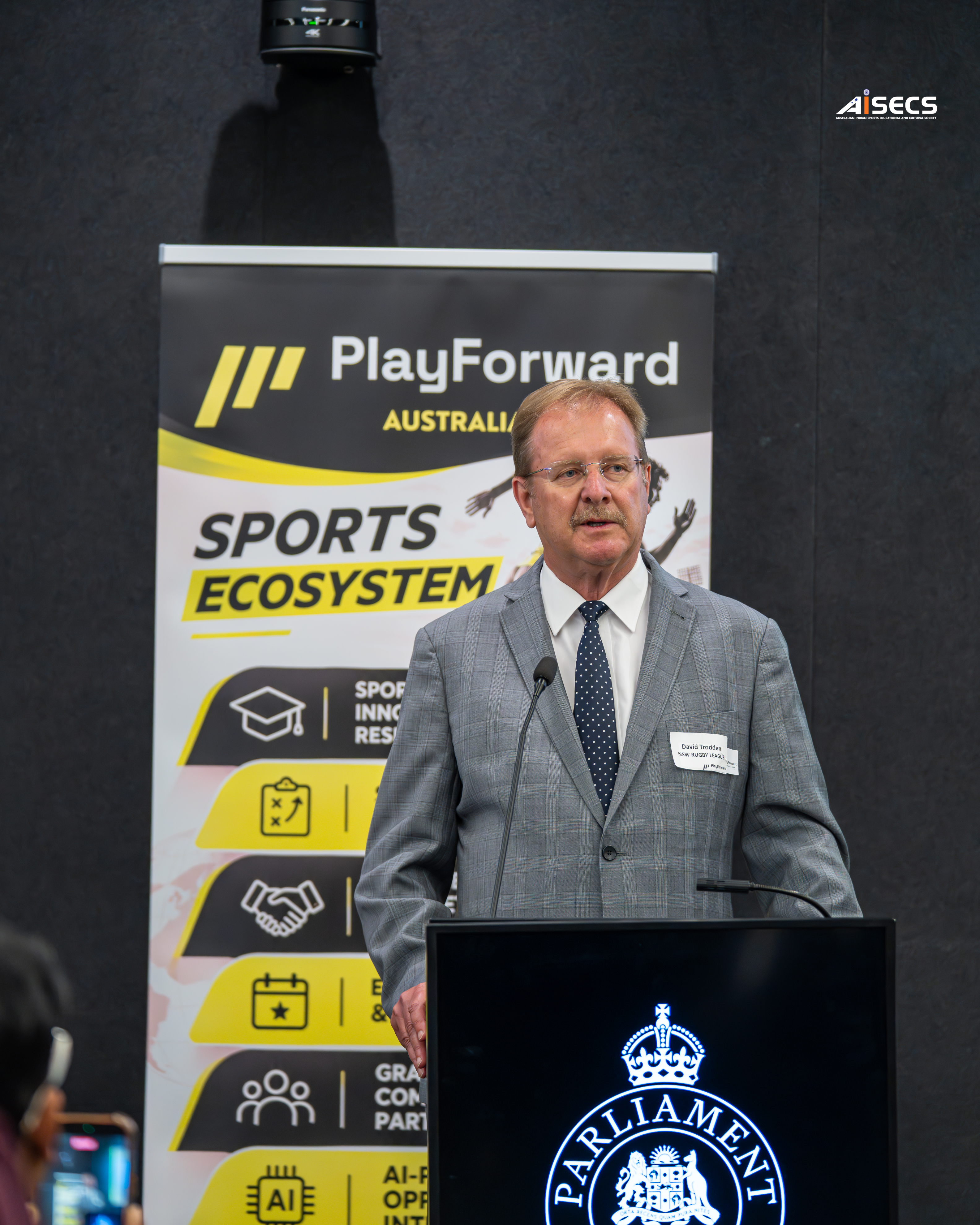
Following the official launch of PlayForward at the Parliament of New South Wales, the initiative reached another important milestone by signing a Memorandum of Understanding with NSW Rugby League.
The agreement brings together PlayForward's Australia–India sporting focus and the experience of an organisation with a long history in one of Australia's most established sports.
NSW Rugby League operates across a broad sporting environment. Its responsibilities and activities extend beyond elite competitions to community rugby league, junior development, women's participation, regional clubs, volunteers and the administration of the game across New South Wales.
For PlayForward, the relationship provides an opportunity to explore how established Australian sporting expertise might connect with organisations and emerging opportunities in India.
The significance is not that an international programme has already been delivered. It is that a relationship has been established from which potential areas of cooperation can be explored.
These could include coaching and administration knowledge, grassroots development, player pathways, community participation, education, sporting events and connections between clubs and academies.
The MOU should be viewed as a starting point. Its longer-term value will depend on what both parties choose to develop through the relationship.
First, an important distinction: Rugby league is not rugby union
Before looking at potential Indian partners, there is an important distinction that needs to be understood.
Although the two sports share the word rugby and have common historical origins, rugby league and rugby union are different codes, with separate rules, competitions and international governing structures.
Rugby league is the 13-a-side code played in Australia's National Rugby League (NRL) and NSW Rugby League competitions.
Rugby union is the 15-a-side code, which also includes the seven-a-side format played at the Olympic Games.
India has a recognised national governing body for rugby union, but rugby league has a separate and much newer administrative structure.
This matters because an Australian organisation seeking to work with Indian rugby league should identify the appropriate rugby league body, rather than assume that the established rugby union federation administers both codes.
Rugby India: The established governing body for rugby union
Rugby India (@RugbyIndia) on XRugby India
Official website: rugbyindia.in
National governing body for rugby union in India, including 15-a-side, sevens and other formats.
Founded in 1998, Rugby India is the Indian Rugby Football Union (IRFU), recognised by India's Ministry of Youth Affairs and Sport and a full member of World Rugby, Asia Rugby and the Indian Olympic Association.
Its remit covers the development of rugby across the country, from grassroots participation to high-performance sport. Its official website identifies 26 member state associations and units and includes formats such as rugby union, sevens, touch, tag, flag, beach and wheelchair rugby.
Rugby India+1Rugby India's development work also reaches schools and universities. Rugby is included in the School Games Federation of India for boys and girls in the Under-14, Under-17 and Under-19 age groups, as well as the National University Games.
This is a substantial institutional network to understand when considering wider Australia–India rugby cooperation.
Its state associations include organisations in Maharashtra, Odisha, Karnataka, Tamil Nadu, Kerala, Gujarat, Punjab, Delhi, West Bengal, Assam, Manipur and other states.
Rugby IndiaThere is also a significant development in its club structure. In January 2026, Rugby India introduced a National Club Accreditation Policy designed to strengthen the domestic club system and provide recognised clubs with pathways into national 15-a-side club championships.
The policy includes requirements relating to registered players, state or district association recognition, suitable playing facilities, certified coaching and medical support.
Rugby IndiaFor Australian rugby union organisations, this creates areas worth exploring in coaching education, club development, women's rugby, athlete pathways and high-performance support.
But for the PlayForward–NSW Rugby League relationship, another organisation is more directly relevant.
Rugby League India: The emerging national rugby league structure
Rugby India (@RugbyIndia) on XRugby League India
International governing body: International Rugby League
A developing national rugby league federation with international observer membership.
The most significant development for the NSW Rugby League connection came on 1 September 2026.
International Rugby League (IRL), the global governing body for rugby league, announced that Rugby League India had been approved as its 57th national federation and the third in Asia.
The decision followed a 20-month application process. Rugby League India's admission as an Observer Member was approved by a vote of IRL's full member nations.
Rugby League International FederationThis is an important step for a sport seeking to establish stronger foundations in India.
According to the IRL announcement, Rugby League India is registered in Andhra Pradesh. Its nine founders have experience in rugby administration and come from different parts of India, with connections to sporting enthusiasts in several regions.
The organisation's stated priorities include:
Building stronger domestic structures for rugby league.
Increasing participation across India.
Developing pathways for players, coaches and officials.
Establishing state-level organisations.
Creating opportunities for Indian players to progress to international competition.
The announcement also explains that Rugby League India hopes to formalise state bodies that can become voting members of the national federation and manage development in their respective territories.
There is an important qualification here. Observer membership of International Rugby League is an international recognition milestone, but it should not be confused with full membership or automatic recognition by every Indian government sports authority. The IRL announcement itself describes the work still required to establish state structures and satisfy the wider requirements for national recognition.
Rugby League International FederationThat makes this an early-stage development opportunity rather than an established nationwide competition system.
For NSW Rugby League and PlayForward, however, the timing is significant. An Indian rugby league body is working to build its structures at the same time that an Australian organisation with extensive experience in the game has entered a new relationship with PlayForward.
Why NSW Rugby League's experience could matter in India
The value of a relationship with NSW Rugby League lies in the depth of its experience.
Building a sporting system requires more than introducing a game or organising a tournament. It requires a structure that can support participants throughout their development.
That includes:
Coaching standards and education.
Referee development and match officials.
Club administration and governance.
Junior and age-group competitions.
Women's and girls' participation.
Player identification and development.
Competition operations and scheduling.
Safeguarding, medical support and player welfare.
Volunteer development and community engagement.
These are areas where an established sporting organisation can offer valuable experience.
India's emerging rugby league structure will need to develop many of these capabilities as it builds a sustainable domestic game.
The opportunity is not for Australia to simply export its model. India's sporting environment, geography, resources, institutions and community needs are different.
The more useful approach would be a two-way exchange: Australian expertise contributing to India's development while Australian organisations also learn from India's sporting culture, local networks and developing rugby league community.
This is where the PlayForward relationship could become more meaningful.
A bridge already forming: Indian Heritage Rugby League NSW
Perhaps the most interesting part of this story is that the connection between Indian communities and rugby league is already developing in New South Wales.
In July 2026, NSW Rugby League announced the beginning of Indian Heritage Rugby League NSW.
The initiative began with an inaugural induction meeting at the Parramatta Eels Centre of Excellence, attended by more than 50 people from the Indian and rugby league communities.
Its stated purpose was to increase participation, strengthen cultural connections and create opportunities for people of Indian heritage to become involved in rugby league at different levels.
The initiative received support from NSW Rugby League and emerging elite players, including Onitoni and Ashton Large, both of Indian heritage and representatives of the GIO NSW Under-19s in the 2026 State of Origin Under-19s match.
NSWRLThis is significant because it demonstrates that the Australia–India rugby connection does not have to begin with a formal international tour or a national team.
It can begin with communities, families, young players and local sporting participation.
Indian Heritage Rugby League NSW also has a wider community context. Heritage Rugby League NSW has brought together 25 diaspora groups, creating opportunities for people to celebrate their cultural backgrounds while participating in the game.
NSWRLIndia's debut at the Harmony Nines
The initiative reached another milestone in October 2026.
Indian Heritage Rugby League NSW made its debut at the NSWRL Harmony Nines on 17–18 October, joining 17 other heritage nations at the event.
The tournament, hosted by NSW Rugby League in conjunction with Heritage Rugby League NSW, brought together communities from different cultural backgrounds.
The 2026 event featured 18 heritage nations across 11 divisions, including junior boys' and girls' competitions, open-age men's and women's divisions and emerging divisions.
The Harmony Nines was established in 2009 to increase rugby league participation among culturally and linguistically diverse communities while promoting social inclusion, cultural understanding and community harmony.
NSWRLFor Indian Heritage Rugby League NSW, this was an important first appearance.
For the broader Australia–India sporting relationship, it is an example of how cultural connections can become sporting participation.
It also presents an interesting question: could community-level participation in Australia become a bridge to relationships with developing rugby league communities in India?
That is a possibility worth exploring, rather than an outcome that should be assumed.
What could an Australia–India rugby league collaboration look like?
The PlayForward–NSW Rugby League MOU creates an opportunity to consider several practical areas of cooperation.
These are potential areas for discussion, not confirmed commitments under the agreement.
1. Coaching and technical knowledge exchange
One of the most practical starting points could be coaching development.
NSW Rugby League has extensive experience in coach education, junior development, community competitions and the structures that support player progression.
Indian rugby league could benefit from opportunities to learn about coaching methods, session planning, player development, game understanding and the organisation of training programmes.
A structured exchange could involve online workshops, technical presentations, visiting coaches or shared educational resources, subject to the organisations agreeing on the scope.
The value would be in developing local coaching capability, rather than relying indefinitely on visiting expertise.
2. Building grassroots and school participation
A sustainable sport needs a strong foundation.
In India, the development of rugby league could benefit from structured school and community programmes that introduce the game to young people.
NSW Rugby League's experience in community participation and junior competitions could provide useful reference points.
Potential areas include introductory rugby league programmes, age-appropriate formats, school engagement, community coaching and volunteer development.
The model would need to be designed around Indian schools, local facilities, available coaching resources and safeguarding requirements.
3. Women's and girls' rugby league
Women and girls represent an important opportunity for the future of sport in both countries.
NSW Rugby League's experience in expanding participation and creating pathways for female players could offer useful lessons for developing programmes in India.
Potential areas for cooperation include coaching education, age-group competitions, introductory programmes, player development and leadership opportunities for women in sporting administration.
Any such work would need to be developed in partnership with Indian organisations and respond to local participation needs.
4. Player pathways and talent development
India's emerging rugby league community will need credible pathways for players who want to progress beyond introductory participation.
This could include structured development programmes, age-group competitions, talent identification, coaching support and opportunities to understand the requirements of international rugby league.
For Australian organisations, the relationship could also provide a way to better understand the emerging Indian rugby league landscape.
However, any athlete exchange or selection pathway would need to be developed transparently, with appropriate eligibility, safeguarding, education and welfare arrangements.
5. Refereeing, administration and governance
A successful sport depends on more than players and coaches.
Referees, competition administrators, club officials, medical personnel and volunteers are essential to the delivery of safe and credible competitions.
NSW Rugby League's experience could provide a valuable basis for knowledge exchange in these areas.
For a developing rugby league structure in India, strengthening these capabilities could be just as important as developing playing talent.
6. Sporting events and community connections
There may also be opportunities to explore friendly matches, community festivals, coaching events and rugby league development activities.
An event does not necessarily need to involve elite teams to create value.
A school-level festival, community coaching clinic or club exchange could introduce the game to new participants and build relationships between organisations.
The important consideration would be whether the activity creates a lasting benefit rather than becoming a one-off event.
The Indian organisations and networks worth understanding
For PlayForward, identifying the right Indian partners is a critical part of making the MOU relevant to the wider Australia–India sporting relationship.
The first distinction is between organisations responsible for rugby league and those responsible for rugby union.
Organisation
Code and role
Relevance
Rugby League India
Emerging Indian rugby league federation; IRL Observer Member
The most directly relevant national-level organisation to explore for rugby league cooperation
International Rugby League
Global governing body for rugby league
International governance, membership and development context
Rugby India / IRFU
National governing body for rugby union
Relevant to wider rugby cooperation, but not the governing body for rugby league
Indian Heritage Rugby League NSW
Indian heritage community initiative within NSW rugby league
A practical community bridge between Indian diaspora participation and the Australian game
State rugby associations in India
Rugby union development bodies affiliated with Rugby India
Relevant to union-specific programmes and wider rugby development
The most logical starting point for the rugby league-specific conversation would be to understand the work and priorities of Rugby League India and its developing state network.
Rugby India should be approached separately if the objective expands to rugby union, sevens, school rugby or university rugby.
This distinction will help PlayForward avoid approaching the wrong organisation or presenting a rugby union partnership as a rugby league agreement.
Beyond the national bodies: India's rugby development ecosystem
A national federation is important, but the wider development of a sport depends on the institutions and communities working beneath it.
For rugby union, Rugby India's state association network provides a useful picture of how the game is organised across India.
Its listed associations include:
Maharashtra Rugby Association.
Karnataka Rugby Football Union.
Tamil Nadu Rugby Football Union.
Odisha Rugby Football Association.
Kerala State Rugby Association.
Rugby Football Association of Gujarat.
Rugby Association of Delhi.
Bengal Rugby-Football Union.
Rugby Association of Assam.
Rugby Football Association of Punjab.
These are rugby union structures, not automatically rugby league partners. However, they may be relevant to broader conversations around rugby participation, coaching education, facilities and community development where the appropriate governing bodies agree.
For rugby league, the state-level structure is still developing. Rugby League India's September announcement specifically identified formalising state bodies as part of its next stage.
Rugby League International Federation+1This creates an opportunity to explore how local clubs, schools, universities, coaches and community organisations could participate in the future development of the game.
The important point is to work through the appropriate sporting structures and ensure that any proposed activity is recognised by the relevant governing body.
Why this matters beyond rugby league
The potential value of the PlayForward–NSW Rugby League relationship extends beyond one sport.
It provides an example of how an Australian sporting organisation can connect with a developing sporting environment in India through an independent Australia–India ecosystem.
The same principle could apply across other disciplines.
An established Australian hockey organisation could explore relationships with Indian hockey institutions.
A football organisation could connect with an Indian academy or university.
A volleyball body could explore coaching and community participation initiatives.
A squash organisation could consider athlete and coaching pathways.
A sports science institution could work with partners in India on research, performance support or injury prevention.
The opportunities will differ from sport to sport. But the underlying idea is consistent: identify the organisations with relevant expertise, understand the needs of potential partners and create a practical basis for cooperation.
This is also consistent with the India–Australia Roadmap for Sports Collaboration, launched by Prime Ministers Anthony Albanese and Narendra Modi at the Melbourne Cricket Ground on 10 July 2026.
The roadmap identifies cooperation across high-performance sport, coaching, sports science, technology, grassroots participation, women’s sport, para-sport, major events and sports industry investment.
For PlayForward, the roadmap provides a wider policy context for the kind of institutional and community relationships it wants to help connect.
The role PlayForward can play
PlayForward is not a rugby league governing body, a competition organiser or a replacement for existing sporting institutions.
Its role is different.
It aims to provide a shared environment where Australian and Indian sporting organisations, clubs, academies, athletes, coaches, universities and businesses can discover one another, establish connections and explore areas of mutual interest.
In the context of the NSW Rugby League MOU, that could mean helping identify relevant Indian rugby league organisations, understanding their priorities, mapping potential areas of cooperation and bringing the right people into a conversation.
It could also help make the relationship visible to a wider network of sporting organisations and potential collaborators.
For example, a potential rugby league development programme might involve a combination of an Australian sporting organisation, an Indian federation, local clubs, coaching specialists and an educational institution.
No single organisation necessarily has all the resources or expertise required. The opportunity lies in connecting complementary capabilities.
This is the broader purpose of the PlayForward ecosystem.
What should happen next?
The MOU creates a foundation, but a clear pathway from agreement to practical activity will be important.
A sensible next stage would involve several steps.
First, establish the areas of mutual interest. PlayForward and NSW Rugby League could identify which areas of their expertise and networks are most relevant to potential cooperation with India.
Second, understand the Indian rugby league landscape. Rugby League India and its emerging state network are natural organisations to understand in greater detail. The priorities, governance arrangements and development plans of the Indian federation should guide any proposed collaboration.
Third, identify practical pilot opportunities. Rather than beginning with a large international programme, the organisations could explore a smaller initiative, such as a coaching knowledge exchange, online development workshop or community rugby league programme.
Fourth, develop appropriate safeguards and delivery arrangements. Player welfare, child safeguarding, coaching credentials, insurance, travel, eligibility and local approvals need to be considered before any activity involving participants is undertaken.
Finally, measure what changes. The value of collaboration should be assessed through outcomes such as participation, coaching capability, organisational development, community engagement and the continuation of programmes.
These are recommendations for moving the relationship forward, not a description of activities already agreed under the MOU.
A bigger opportunity for Australian and Indian sporting organisations
The story of rugby league in India is still developing. Its future will depend on the strength of its domestic structures, the commitment of its administrators, the growth of participation and the ability to create credible pathways for players and coaches.
Australia has experience that may be valuable to that journey.
India, in turn, offers opportunities for Australian sporting organisations to develop new relationships, share expertise and engage with a growing sporting landscape.
The emergence of Rugby League India as an internationally recognised observer member, the development of Indian Heritage Rugby League NSW and the PlayForward–NSW Rugby League MOU create an interesting moment to explore what could come next.
The opportunity is not to promise a new international competition or an immediate player exchange. It is to start with the right organisations, understand what each side needs and build something practical.
That is how sustainable sporting relationships are developed.
Taking sport forward, together
The PlayForward–NSW Rugby League MOU is an important milestone in the development of PlayForward's Australia–India sporting ecosystem.
It connects an established Australian sporting institution with an initiative whose ambition is to bring more organisations, communities and opportunities into the Australia–India sporting conversation.
India's developing rugby league structure gives this relationship a particularly relevant international dimension.
There is a potential opportunity to connect Australian experience in coaching, competition administration, grassroots participation and player development with Indian organisations working to establish the foundations of the game.
But the next chapter must be built through genuine engagement, clear responsibilities and practical outcomes.
PlayForward welcomes conversations with Indian sporting federations, rugby league organisations, clubs, academies, schools, universities, coaches and businesses interested in exploring Australia–India sporting collaboration.
The ambition is bigger than one sport and bigger than one agreement.
It is about building relationships that create opportunities for people, organisations and communities in both countries.
The MOU is a beginning. What we build from it is what will matter.
TAKE SPORT FORWARD. PLAYFORWARD.
Visit: www.playforward.au
For Australian and Indian sporting organisations interested in joining the PlayForward ecosystem or exploring collaboration, connect with the PlayForward team.
PlayForward articles distinguish official sources from PlayForward explanation. Nothing here is government policy.