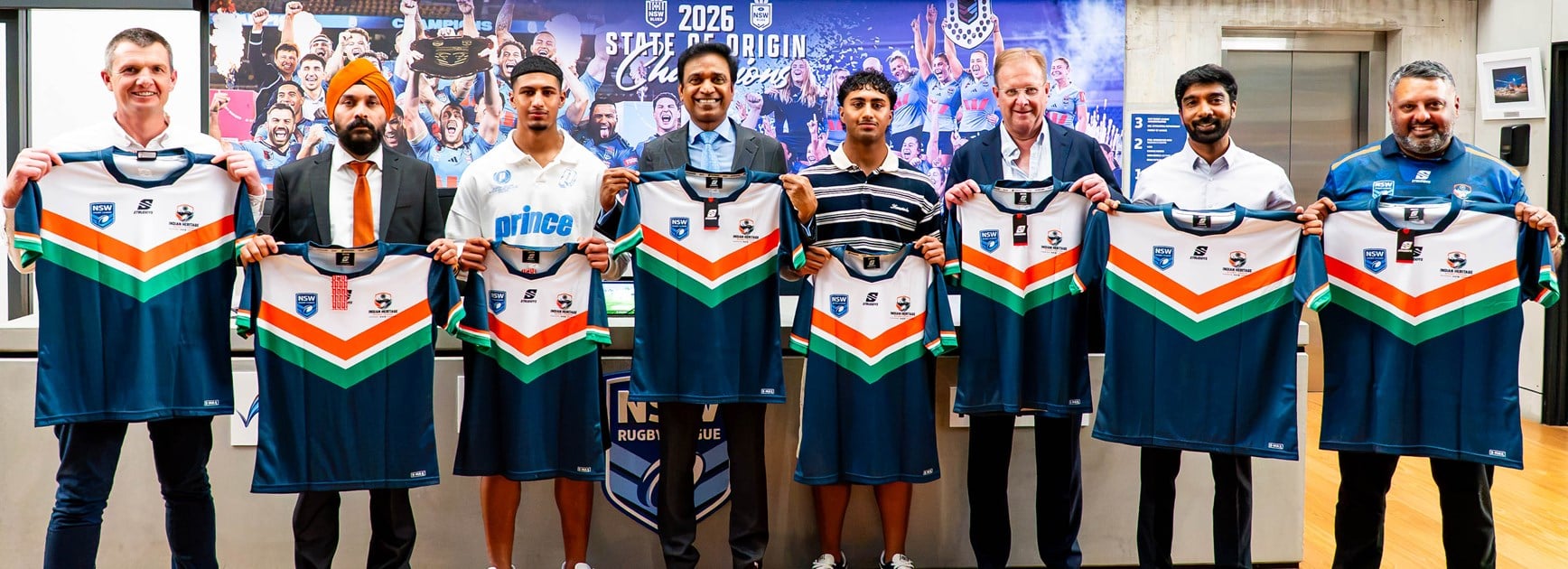
From a community gathering in July to a historic Harmony Nines debut in October, Indian Heritage Rugby League NSW offers a powerful example of how sport can create belonging at home—and open possibilities for a deeper sporting relationship between Australia and India.
A jersey can represent a team. It can also represent a family, a culture, a community and a sense of belonging.
For the Indian community in Australia, the launch of Indian Heritage Rugby League NSW in 2026 carries significance beyond the result of any match. It creates a new opportunity for people of Indian heritage to participate in a sport deeply embedded in Australian community life, celebrate their identity and build connections with people from different backgrounds.
In October, that opportunity became visible on the field.
Indian Heritage Rugby League NSW made its debut at the New South Wales Rugby League (NSWRL) Harmony Nines on 17–18 October 2026 at the Central Coast Regional Sporting and Recreation Complex in Tuggerah. The team joined representatives of 17 other heritage nations in a tournament celebrating rugby league, culture and community.
It was a first appearance, not the culmination of a long-established programme. That distinction matters. The initiative is at an early stage, and its long-term impact will depend on what happens next. But its emergence is worth recognising because it illustrates something important: participation in Australian sport can help communities build relationships, develop confidence and contribute to the country's sporting future.
For PlayForward Australia–India, there is a wider lesson here. The relationship between the two countries is often discussed through international cricket, elite athletes and major sporting events. Those connections matter, but the future of sport is also shaped by the community organisations that make participation possible.
From an idea to the playing field
The story began before the team took the field.
On 20 July 2026, NSWRL reported that more than 50 people attended the initiative's inaugural induction meeting at the Parramatta Eels Centre of Excellence. Members of the Indian community and the rugby league community came together to discuss increasing participation, strengthening cultural connections and creating opportunities for people of Indian heritage across New South Wales.
The initiative was supported by NSWRL, with involvement from emerging elite players. Among them were Onitoni and Ashton Large, both of Indian heritage, who represented the GIO NSW Under 19s in the 2026 State of Origin Under 19s match.
Their involvement is notable because representation becomes particularly meaningful when young people can see that their heritage and sporting ambitions can sit comfortably alongside each other.
The formal launch followed on 12 October at the NSWRL Centre of Excellence. Five days later, Indian Heritage Rugby League NSW made its debut at the Harmony Nines.
That sequence—from an initial gathering to an official launch and then a tournament appearance—shows early momentum. It does not yet establish how large the programme will become, how many people will participate in future seasons or whether it will produce elite-level players. Those outcomes remain to be seen.
What is confirmed is that a new opportunity has been created for people of Indian heritage to become involved in rugby league.
And that is a meaningful beginning.
Why heritage sport matters
Sport is often described as a universal language. The phrase is familiar, but its real value becomes clearer when people have an opportunity to participate rather than simply watch.
A local club can introduce a young person to teammates outside their usual social circle. A volunteer role can bring families together. A competition can help people learn the traditions of another community while sharing their own. Over time, these ordinary interactions can build familiarity and trust.
Heritage rugby league provides a setting for those connections.
The NSWRL Harmony Nines has been running since 2009, with a focus on increasing participation among culturally and linguistically diverse communities and encouraging social inclusion, cultural understanding and community harmony. The 2026 tournament featured 18 heritage nations across 11 divisions, including junior, men's, women's and emerging competitions.
The Indian team's participation places the community within an established multicultural sporting environment rather than creating a separate event disconnected from the wider game.
That distinction is important. Celebrating cultural heritage and participating in Australian sport are not competing ideas. They can reinforce each other.
A person should not have to leave their heritage at the gate to belong to a sporting club. Equally, a heritage team can be a starting point for wider participation in the sport, including volunteering, coaching, officiating and supporting local competitions.
The opportunity is to make the pathway welcoming and sustainable.
For Indian Heritage Rugby League NSW, the next test will be whether the enthusiasm surrounding the launch translates into continued participation, effective organisation and opportunities for people at different ages and stages of their sporting lives.
Rugby league is part of Australia's multicultural story
Rugby league has a long and evolving relationship with Australia's multicultural communities.
In a 2023 report, NSWRL stated that players registered across its competitions had family heritage connected to 183 countries. The organisation also highlighted the growth of heritage teams representing communities from around the world. These figures reflect the diversity of the game at that time, rather than a current count of Indian participants.
Heritage Rugby League NSW was formed in 2022 and affiliated with NSWRL. Its stated objectives include increasing multicultural participation, creating pathways for people of different ethnic backgrounds and supporting relationships between heritage clubs and their respective countries of origin.
Indian Heritage Rugby League NSW is a recent addition to this broader structure.
Its importance should not be measured only by whether the team wins matches. Success could also mean more young people trying the sport, more families feeling welcome, more volunteers developing skills and stronger relationships between the Indian community and the wider rugby league network.
These are outcomes to work towards, not achievements that can already be claimed. Measuring them over time would help the initiative demonstrate its impact and identify where further support is needed.
There is also a wider lesson for sporting organisations. Inclusion is not achieved simply by announcing that a sport is open to everyone. It requires practical entry points, clear information, supportive environments and people who are prepared to help newcomers find their place.
A team can create the invitation. The broader sporting system must help keep that invitation open.
What could this mean for Australia–India sporting ties?
Australia and India are strengthening their sporting relationship at a time when both countries are preparing for major international events and exploring opportunities beyond traditional sporting connections.
In July 2026, Australian Prime Minister Anthony Albanese and Indian Prime Minister Narendra Modi announced the India–Australia Roadmap for Sports Collaboration. The roadmap builds on the countries' 2023 Memorandum of Understanding on Cooperation in Sports and identifies priorities including capacity building, sports science and technology, major sporting events, sports industry cooperation and women's sport.
It recognises that sporting relationships involve more than governments. Sporting bodies, businesses, universities, state-level governments and community groups all have a role in developing practical cooperation.
This is where the experience of community initiatives becomes relevant.
Indian Heritage Rugby League NSW is not identified as a project under the bilateral roadmap, and there is no basis to describe it as a government-to-government partnership. The roadmap does not specifically name this initiative or establish a rugby league exchange programme between Australia and India.
Nevertheless, the team's emergence offers a useful example of the kind of community-level sporting activity that can sit within the wider conversation about people-to-people connections.
If opportunities emerge in the future, they could include sharing knowledge about community participation, discussing coaching and volunteer development, connecting sporting administrators or exploring how rugby league is experienced in different settings.
Such ideas would need interested organisations, appropriate resources and clear agreement before they could become actual projects. They should be treated as possibilities to explore, not commitments that have already been made.
The starting point is simple: Australia–India sporting cooperation should not be limited to the sports that already dominate headlines. There is value in understanding the different sporting cultures, community structures and participation opportunities that exist in both countries.
The opportunity ahead of Ahmedabad 2030 and Brisbane 2032
The decade ahead gives this conversation added context.
India is preparing to host the 2030 Commonwealth Games in Ahmedabad, while Brisbane is preparing for the 2032 Olympic and Paralympic Games. The bilateral sports roadmap identifies these milestones as part of a wider period of opportunity for cooperation.
Major events can create interest in sport, but their lasting value depends on what happens before and after the competition itself.
Community organisations need pathways through which people can become involved. Coaches and volunteers need opportunities to develop. Sporting bodies need to understand their communities. Young participants need environments in which they can continue playing as their circumstances change.
Heritage teams can contribute to this wider sporting ecosystem by providing accessible ways to participate and helping people connect with the sport and with one another.
There is no reason to claim that Indian Heritage Rugby League NSW will automatically lead to international exchanges or Olympic opportunities. Rugby league is not itself an Olympic sport, and this particular initiative has not been announced as part of the bilateral roadmap.
Its relevance is more immediate and grounded: it creates an opportunity for Indian Australians to participate in a major Australian sport and contribute to the community structures that sustain it.
That is valuable in its own right.
International sporting relationships are stronger when the wider community has opportunities to engage with sport—not only when national teams meet on the biggest stages.
Where PlayForward Australia–India fits
This is the wider sporting landscape that PlayForward Australia–India wants to help bring into focus.
PlayForward is being developed as a platform for connections and opportunities across the Australia–India sporting ecosystem. Its focus includes sporting organisations, clubs, athletes, coaches, administrators, businesses, manufacturers, universities, researchers, technology innovators and community groups.
The Indian Heritage Rugby League NSW story is relevant because it reminds us that sport is built at many levels.
Elite performance matters. Major events matter. Commercial investment and technology matter. But so do local clubs, community leaders, volunteers and the people who create opportunities for others to participate.
PlayForward's role is to encourage awareness of relevant opportunities and connections across this broader ecosystem. It is not an organiser or official partner of Indian Heritage Rugby League NSW, NSWRL or the Harmony Nines, and it does not claim to have facilitated this initiative.
There may, over time, be opportunities for interested organisations in Australia and India to learn from one another, share knowledge and explore new sporting connections. Those conversations should be grounded in genuine interest, mutual benefit and practical possibilities.
For people working across sport, the question is how to turn broad enthusiasm for Australia–India relations into useful, lasting engagement. Community initiatives such as Indian Heritage Rugby League NSW offer a concrete starting point for that discussion.
The next chapter belongs to the community
The debut of Indian Heritage Rugby League NSW at the 2026 Harmony Nines is a beginning, not a finished story.
The initiative's future will depend on whether it can build participation, support its players, develop its volunteers and maintain strong relationships with the wider rugby league community. Those are the measures that will matter over the coming years.
But the significance of the moment should not be overlooked.
A new heritage team has entered an established multicultural competition. People of Indian heritage have a new opportunity to connect through rugby league. And the wider sporting community has another example of how Australian sport can make room for different cultures while bringing people together around a shared game.
For Australia and India, the broader lesson is that sporting relationships are built through more than international fixtures and official announcements. They grow through participation, shared experience and the willingness to create opportunities for people to connect.
PlayForward Australia–India invites sporting organisations, clubs, athletes, coaches, researchers, businesses and community leaders to join that wider conversation.
If you believe sport can build stronger communities, create new connections and open opportunities between Australia and India, there is a place for you in the conversation.
The future of sport is not shaped only by those who represent a country. It is also shaped by the communities that make participation possible.
Sometimes, the first step towards a bigger sporting relationship is a team pulling on a jersey for the very first time.
- NSW Rugby Lee
- NSW Rugby League — Indian Heritage Rugby League NSW begins journey
- NSW Rugby League — Indian Heritage Rugby League launch
- Australian Government — India–Australia Roadmap for Sports Collaboration
PlayForward articles distinguish official sources from independent explanation. Nothing here is government policy.