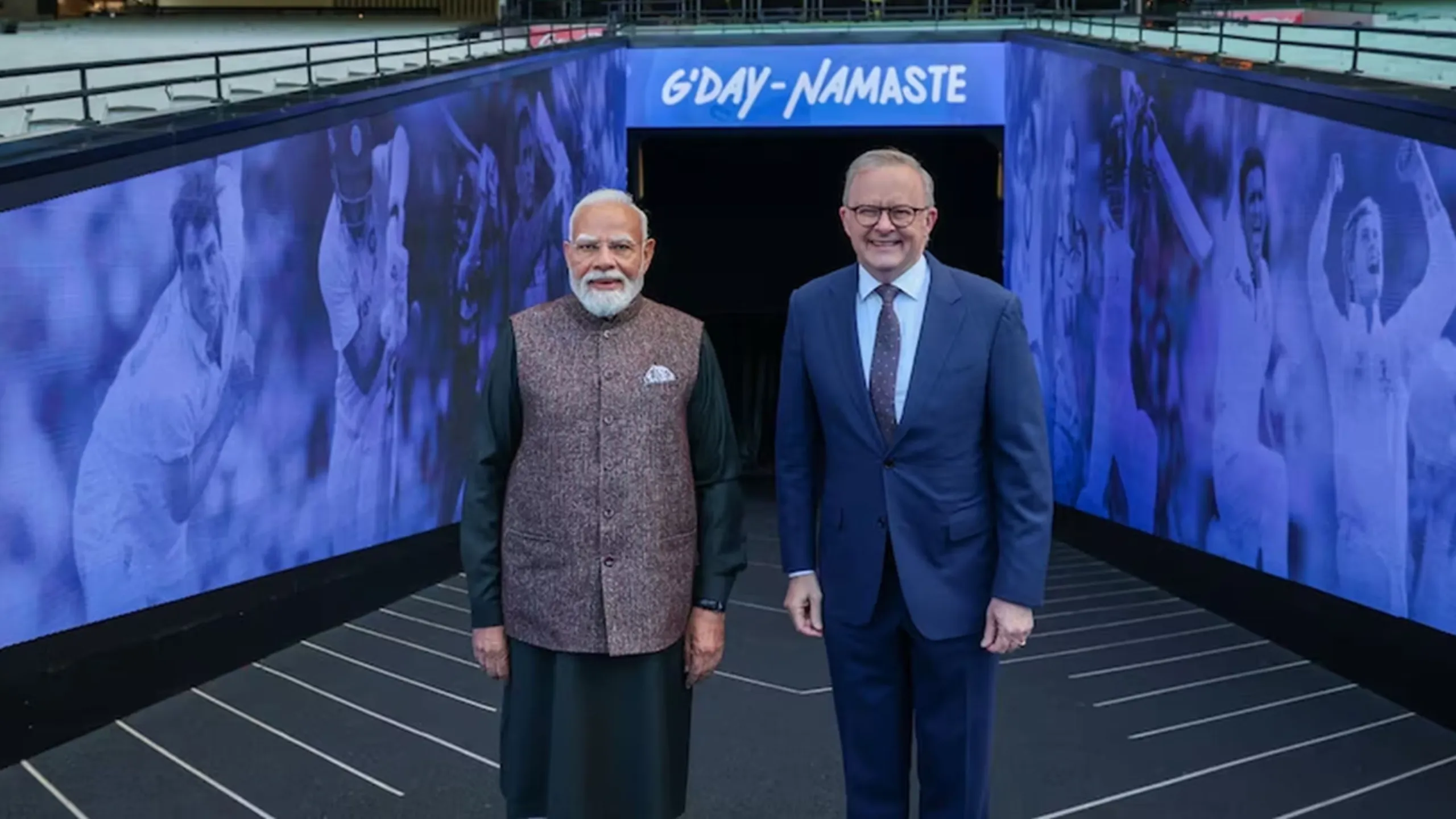
On 12 December 2026, the Big Bash League is scheduled to open its season in Chennai, with the Melbourne Renegades facing the Perth Scorchers at the M. A. Chidambaram Stadium. It will be the first Big Bash League fixture played outside Australia and, according to the Australian Government's announcement, the first time a foreign cricket league has played a match in India.
The match will anchor G’Day Namaste, a week-long festival across India featuring Australian sport, culture and business engagement. A senior business delegation led by the Business Council of Australia is also planned.
These announcements followed the meeting between Australian Prime Minister Anthony Albanese and Indian Prime Minister Narendra Modi in Melbourne on 10 July 2026, when the leaders also announced the India–Australia Roadmap for Sports Collaboration.
It is an exciting moment for the relationship between the two countries. But its importance should not be measured by the novelty of a cricket match alone.
The more interesting question is this: can G’Day Namaste help turn the enthusiasm people already feel for Australia and India into stronger relationships between sporting organisations, businesses, educational institutions and communities?
That is where the opportunity lies.
Sources: Australian Government announcement; joint media statement from Melbourne.
Why this moment matters
Australia and India already have a substantial sporting connection. Cricket is its most visible expression, but the relationship also encompasses coaching, sports science, athlete development, event management and the business of sport.
The significance of the December match is that an Australian domestic sporting competition will take place on Indian soil. The fixture creates an opportunity to introduce the Big Bash League to audiences in India while bringing an Australian sporting product into a market with an established passion for cricket.
For Cricket Australia, it is an opportunity to extend the competition's reach. For Indian audiences, it offers a chance to experience the league in person. For the broader bilateral relationship, it provides a high-profile occasion around which sporting, cultural and business activities can be organised.
Those are reasonable opportunities, not guaranteed outcomes. Actual attendance, viewership, commercial returns and longer-term audience growth will need to be assessed after the event.
There is also a wider point. International relationships are not built exclusively in diplomatic meetings. They develop through repeated interactions between people who work together, share knowledge and discover common interests. Sport can create the occasion for those interactions.
G’Day Namaste has the potential to bring several of those connections into one programme.
More than a cricket fixture
The Australian Government has described G’Day Namaste as a week-long festival across India featuring Australian cultural, sporting and business activities. Its announced business component includes a senior delegation led by the Business Council of Australia.
That combination is worth paying attention to.
A sporting event attracts fans, but a sporting ecosystem also includes equipment manufacturers, broadcasters, event organisers, technology companies, universities, coaches, researchers and service providers. Cultural engagement can help people understand one another, while business engagement can give organisations a reason to explore specific commercial relationships.
Bringing these elements together creates an opportunity to start conversations that would not necessarily emerge from a sporting fixture alone.
For example, a sporting organisation might want to understand how another country develops coaches. A technology company might be exploring a new market. A university might be interested in collaborative research. A business might have expertise in event operations or sports equipment.
These are examples of potential areas of engagement, not announcements of projects already agreed through G’Day Namaste.
The real value will depend on whether relevant organisations meet, identify genuine needs and establish practical next steps.
The Roadmap gives the relationship a wider purpose
G’Day Namaste is taking place alongside a significant policy development: the India–Australia Roadmap for Sports Collaboration.
Published by Australia's Department of Foreign Affairs and Trade, the Roadmap identifies five broad areas for cooperation:
Capacity building: high-performance sports centres, coach development, coach-educator exchanges, physical education and Para sport.
Sports science and technology: research into performance analytics, injury prevention, nutrition, wearable technology, recovery and related fields.
Major sporting events: sharing event-delivery expertise and exploring competitions, facilities and support networks.
Sports industry and investment: collaboration in equipment manufacturing, broadcasting, event management, start-ups and market access.
Women in sport: initiatives supporting women's leadership, health, high performance and participation, including potential bilateral tournaments.
The Roadmap also identifies the opportunity to build on the Sports Industry Summit scheduled for Mumbai in December 2026.
This is important because it gives the sporting relationship a broader direction. It recognises that cooperation can involve not only the athletes who compete, but also the people and organisations responsible for developing, delivering and supporting sport.
The Roadmap does not mean that every proposed activity is already funded, operating or guaranteed to proceed. It sets out priorities to be pursued through relevant institutions, with implementation dependent on resources, partnerships and agreed arrangements.
That is a sensible basis for cooperation. The next challenge is to identify where those priorities can translate into useful work.
Source: India–Australia Roadmap for Sports Collaboration — DFAT.
From Chennai to Ahmedabad 2030 and Brisbane 2032
The timing also matters because Australia and India are looking towards major sporting milestones.
India is preparing to host the 2030 Commonwealth Games in Ahmedabad, while Queensland will host the 2032 Olympic and Paralympic Games in Brisbane. The Roadmap explicitly recognises the opportunity to use the build-up to these events to deepen cooperation between sporting bodies.
The practical possibilities extend well beyond the ceremonies and competitions.
Major events require people with expertise in venue operations, accessibility, transport, event technology, workforce development, athlete support, broadcasting, logistics and many other areas. Sporting organisations also need effective coaching pathways, performance support and systems that help athletes prepare and compete.
Australian and Indian organisations may be able to learn from each other's experience in these areas. Businesses may identify products or services that meet genuine needs. Universities may find opportunities for research or education partnerships.
However, neither the Roadmap nor the existence of these Games guarantees contracts, funding or access to procurement. Each opportunity will have its own requirements, processes and decision-makers.
The sensible approach is to use the years ahead to build knowledge and relationships, rather than waiting until a major event is approaching and assuming that opportunities will automatically follow.
What would make G’Day Namaste successful?
My view is that the festival's lasting significance should be judged by more than the visibility of its events.
A successful programme should create opportunities for meaningful engagement and make it easier for interested organisations to understand where they might work together.
That does not require every conversation to become a commercial deal. Some valuable outcomes may be new professional relationships, a clearer understanding of another market, a research discussion or an exchange of knowledge.
Over time, useful indicators could include the number and quality of business and sporting engagements, the follow-up discussions that take place, the partnerships formally established and the projects that move into implementation.
These are suggested measures for assessing longer-term impact, not official targets announced for G’Day Namaste.
It is equally important to recognise that a week of activity cannot, by itself, establish a lasting bilateral network. Relationships require follow-through, clear responsibilities and a reason for participants to remain engaged.
The festival can create the occasion. The people and organisations involved must determine what happens next.
Where PlayForward Australia–India fits
This is the space in which PlayForward Australia–India wants to contribute.
PlayForward is being developed as a sports connection and opportunity platform focused on the wider Australia–India sporting ecosystem. Its purpose is to help bring attention to relevant opportunities and encourage connections between sporting organisations, businesses, universities, researchers, coaches, athletes, officials, technology innovators and community groups.
G’Day Namaste provides a timely example of why that wider ecosystem matters. The Big Bash League match creates a visible sporting moment. The Roadmap identifies areas where deeper cooperation may be possible. The challenge is helping people understand those areas and explore where their own capabilities, experience and interests might fit.
A business interested in sports technology may have different needs from a coach seeking professional development. A university looking for a research partner will need a different kind of connection from a manufacturer exploring market access. A community organisation may be interested in participation or youth development rather than commercial opportunities.
PlayForward's developing role is to help surface those possibilities and encourage purposeful conversations across these different parts of the sporting community.
It is not a government programme or an official organiser or delivery partner of G’Day Namaste. It cannot guarantee introductions, funding, contracts, partnerships or sporting outcomes. Any collaboration will depend on the people and organisations involved and the arrangements they establish.
But there is a clear reason to invite more people into the conversation: the future of Australia–India sport will be shaped by many more people than those who take the field.
An invitation to be part of the next chapter
Australia and India have an opportunity to use G’Day Namaste as more than a moment of celebration. They can build on the attention created by sport to explore practical connections across business, culture, education, technology and community participation.
The Big Bash League's Chennai fixture is an important milestone. Ahmedabad 2030 and Brisbane 2032 provide longer-term reasons to share knowledge and strengthen sporting capability. The India–Australia Roadmap gives the relationship a framework for exploring those opportunities.
What happens next will depend on the quality of the connections made and the work that follows.
At PlayForward Australia–India, we welcome interest from sporting organisations, businesses, universities, researchers, coaches, athletes, officials, sports technology companies, manufacturers and community groups in both countries.
If you have experience to share, a challenge worth exploring or an idea that could benefit from an Australia–India connection, we invite you to join the conversation.
G’Day Namaste can open a door. The opportunity is what we build after walking through it.
Join PlayForward Australia–India. Bring your expertise, your ideas and your ambition. Let's explore how Australia's and India's sporting communities can connect, learn and create lasting value together.
COVER PICtURE CREDIT - CDN.NAREDRAMODI.IN VIA.insidethegames.biz
PlayForward articles distinguish official sources from independent explanation. Nothing here is government policy.